The Platform

Three layers, integrated as one deterministic system.

Detection and mapping only matter if the answer is right. Every layer of the SubTerra Intelligence platform is built around that constraint — from how data is collected to how it's judged.

01 · Carrier

Anumá Airship
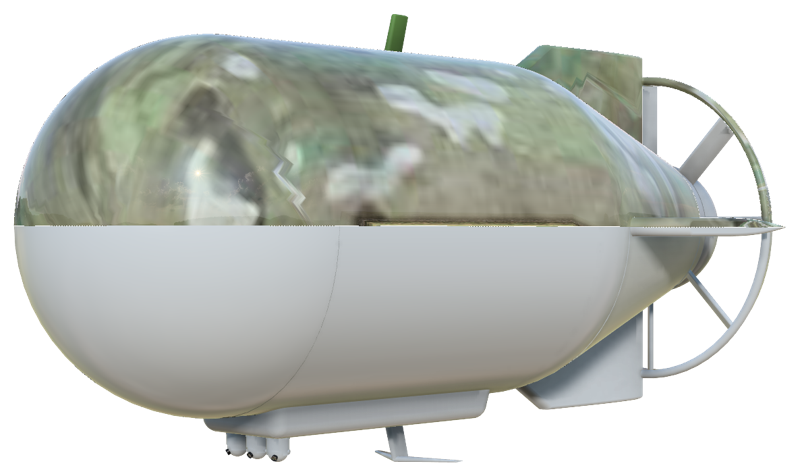
3D render of the Anumá Airship — a partial-vacuum lift carrier platform

The Anumá Airship is a partial-vacuum lift (PVL) carrier platform that flies sensor payloads over contaminated ground — gas-free, US-patented lift technology with no helium or hydrogen to resupply. It's designed to remain aloft for up to 730 days without landing.

  • Carries the 3rd-party sensor technology payload across large survey areas, hours to days on station.
  • Powered by solar and battery, with in-field recharging possible at any farm or village along the route.
  • Operates over open agricultural and rural terrain without requiring the ground infrastructure a vehicle-based survey would.

Proven, not conceptual

The lift mechanism is already built and flight-tested — a geodesic carbon-fiber frame that rises by pumping air out and descends by letting air back in. It's currently at TRL 4–5 on the standard 1–9 Technology Readiness Level scale, used across the EU and US Department of Defense: validated in a lab environment and in a relevant, real-world-like environment. Watch the mechanism explained →

02 · Sensing

3rd-Party Sensor Technology

No single sensor sees everything a buried mine or piece of unexploded ordnance can look like. The platform integrates up to nine sensor technologies working together, so the blind spot of one is covered by another.

  • Magnetometer, ground-penetrating radar (GPR), metal detector, LiDAR, and SAR — each suited to different depths, materials, and ground conditions.
  • Thermal/IR, optical/multispectral, hyperspectral, and multispectral-thermal fusion round out the suite.
  • Six of the nine are independent of ambient light, enabling continuous day-and-night survey.
  • Raw sensor data feeds directly into Genetix Software for analysis.
03 · Analysis

Genetix Software

Genetix Software — the Genetix Context Core — is the layer that turns raw sensor data into an actual answer: is this a mine, is it something else, and how confident is that call. It works in three steps.

  • Fuse — every connected sensor stream is cross-referenced against the others, not read in isolation.
  • Match or escalate — if evidence clearly matches a validated precedent, it classifies. If not, it doesn't guess — it escalates to a human expert.
  • Learn — the expert's answer is permanently added to the ground-truth library, extending the system's context for every future flight.

Why this matters

A false negative here isn't an inconvenience — it's a life. So the system is built to know what it doesn't know, and to defer to a person when it does, rather than output a probability and move on.

Why It Lasts

The Moat

Hardware can be sourced. Ground truth cannot be bought.

  • Replicable — sensor hardware, the airship, and the software architecture can all be sourced or reconfigured by someone else.
  • Defensible — the expert-validated ground-truth library cannot. Every uncertain case Genetix Software escalates, and every answer a human expert gives, is permanently retained.

The system gets measurably better with every deployment, specifically where it was previously weakest — a competitor with identical sensors and an identical airframe still can't buy years of field-validated precedent.

Want the fuller picture?

See why we're starting with agricultural land in Ukraine, and the plan to map all 139,000 km² over time.

Read our approach